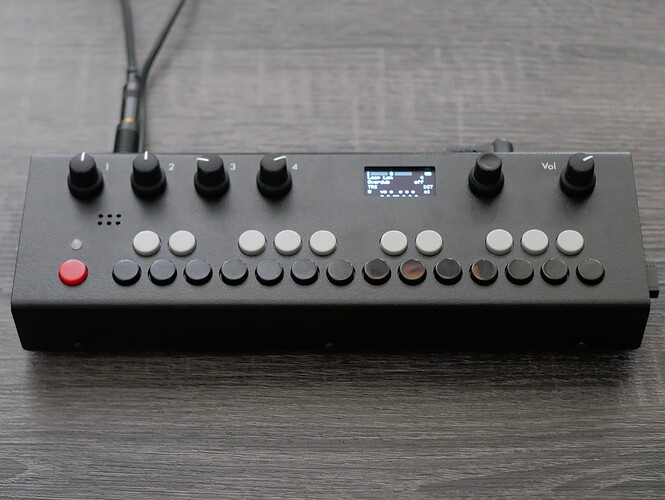
The story behind this second, updated version of the original ORHACK by Audivit (https://patchstorage.com/orhack/) is worth mentioning.
I don’t have any experience in Pure Data programming; I just bought an Organelle on the second-hand market with ORHACK 2 already installed directly by the patch author, who is from my own country.
I really appreciate his work, so I thought it was a good idea to share all his efforts with the community, especially since he got tired of programming and is now focusing on playing acoustic instruments.
Now, let’s talk about the UPDATES IN ORHACK 2:
1. SYSTEM (C# button)
This menu has been expanded. Hitting the AUX button in this menu will display the panning of the 4 tracks.
• D# button: Contains the MULTICLOCK—4 separate clocks that can be assigned to different sequencers.
• F# and G# buttons: Here you will find 2 MODULATION MATRICES, offering a very simple way to assign modulations. In this menu, modulations are assigned globally to each track*. Pressing AUX changes the modulation source between: 4 LFOs, 4 RANDOM generators, 4 MORPHERS, and the ENVELOPE FOLLOWER.
• A# button: The ENVELOPE FOLLOWER, which can use an external audio source to modulate internal parameters.
• C# and D#: SEND FX, just like in the previous version.
• F# (KEYBOARD): A new function that lets you decide how the Organelle keyboard operates in relation to the selected patch chains/tracks. Setting act. dest to 0 means the keyboard always plays the patch you are currently viewing/editing; act. dest 1 to 14 correspond to each of the white keys, directly triggering the respective patches.
• G# (SPLIT): Splits the Organelle keyboard into different octaves. This is very useful for synths, though it applies the split globally to all patches/chains (so it might not be ideal for drum programming).
• A#: RECORDER.
2. OTHER CHANGES i can tell, but they are many others:
NEW EFFECTS and AMPS, alongside the older ones, which can still be found in the LEGACY folder.
The MODULATION MATRIX can be used on each single SYNTH, not only globally as said before (*).
SYNTH PLAITS or PLAITS+ (which is the expanded version) can change the algorithm by pressing AUX button.
The organelle i am using has been modified, as the cpu clock has been boosted from 1.2gHz to 1.5gHz. I can say that is very stable compared to the normal one, but if overloaded can glitch as well as the original one. So my advice is to pay attention to the CPU bar that shows how it is going.
The author intended to make ORHACK even more complete and user-friendly with this new version, but spending too much time programming on the computer made him lose his passion for it. Because of this, you might find a few things that don’t work properly or are unfinished (like the LOOPS looper, which I haven’t managed to get working yet). However, I have been using it for two months now and there is way too much great stuff in here to ever get annoyed or bored.
So, if anyone wants to pick up the project and improve it further, we would be super happy!