
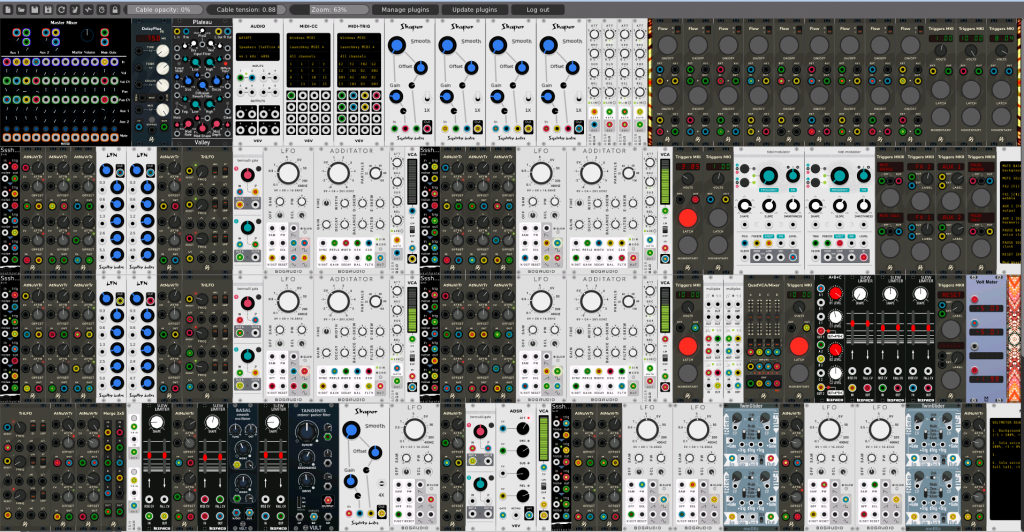
This patch is designed for live performance, specifically something “spacey” to fit between more intense, rhythmic opening and closing sections. Comprising 4 Additator arpeggiated “background” voices (created by adjusting the partial control slowly) and 1 “solo” voice using Vult’s Basal, user controls (described in the Notes modules within the patch) turn on and off pitch wobble, harmonic skew, and “stuttering” of the Additator voices, plus distortion on all voices. MIDI controller #1 (mod wheel) affect the solo voice in a general way. Either voice can be muted with a fade-in or out of ~ 1 second.
The Bogaudio LFO’s to the left of each Additator control note production. The square output sends a pulse to a Bernoulli gate to decide if a note should be played or not. At the same time, the rising sawtooth output is applied to the “Partials” modulation input, which causes partials to be slowly added to the fundamental, so it sounds like an arpeggio.
The LFO square output also triggers three sample & hold modules. The output of one goes to the Additatot V/Oct input to set the base pitch, the second to the “Width” input, so all partials are usually non-harmonic, stretched or compressed, and the third to the “OSK” (odd partial skew), which changes their spacing relative to Width (which sets even-partial spacing), making the sound more complex.
If AUX2 is enabled, the LFO triangle output is connected to the Additator’s ESK (even-partial skew) input.
When FX1 is enabled, a Squinkly Labs LFN modulates each Additator’s base frequency, producing a wobbling note.
Enabling AUX1 mixes the pulse outputs of the 4 LFOs at the lower right of the patch with a constant voltage to set the individual output levels, resulting in a stuttering effect. The LFO outputs are slightly slew-limited by the moDllz TwinGliders to prevent popping. Pulse width is modulated by the sine output of the 4 LFO controlling the Additators.
Enabling FX2 boosts the gain on the Squinky Labs Shapers, providing rough distortion.
Two Tidal Modulator modules control the overall probabilities of a new background or solo note by modulating the “p” input of the Bernoulli gates. Either or both can be frozen at any time.The output is a lopsided sine-like waveform, the negative part bigger (corresponding to a probability of 1).
A typical performance runs approximately 12-22 minutes.
A video recording is available at https://youtu.be/Rt20fqvv4W4
