
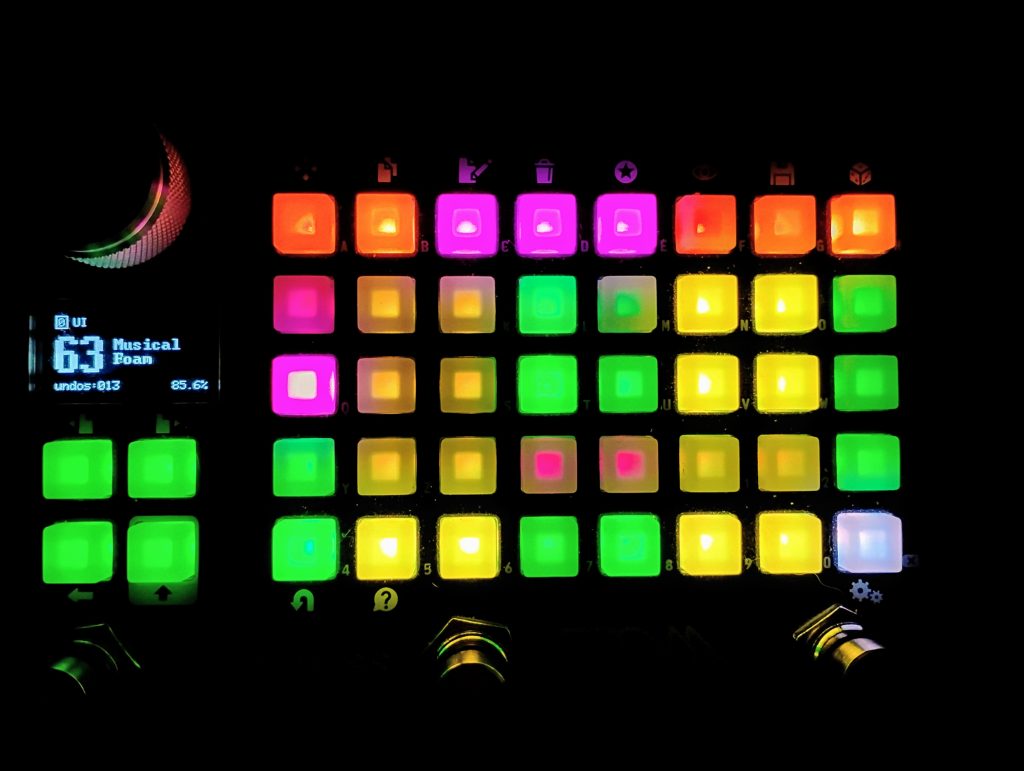
UPDATE 1.1: The H&S community has also complained that the original’s clock speed can’t go slow enough. Made some small changes to connections and modules to improve this patch’s sound at very slow clock speeds.
This is an adaptation of Herbs and Stones’ Liquid Foam modular groovebox… thingy. I copied most of the original design exactly and then made adaptations to address complaints from the community, making the synth more musical and adding delay / reverb.
BASIC OPERATION: Connect yellow outputs to the pink inputs and adjust the values of the green knobs.
—————————————————————-
For those who are interested, here is an explanation of how the original Liquid Foam works:
(disclaimer: sometimes the hardware Liquid Foam acts unpredictably, and I can’t always tell if it is functioning as intended… I built what I think I understand it to intend to do)
In short, you have two sequencers (yellow) to produce gate outputs that route to the inputs (pink). The three note inputs at the top (Notes A, B, and C) are used to produce up to seven different tones depending on which of the three are receiving a gate at the time.
Sequencer A (left) is driven purely by the clock (top left). It advances on each pulse. To the left of Sequencer A, inputs to Mod X cause two steps to fire at once, and inputs to Mod Y cause the sequencer to skip a step.
Sequencer B (right) is a cascading series that also advances at the same speed as the clock. However, the series only starts when a clock signal is received during the ON gate of the square LFO, and multiple series can be cascaded at the same time, triggering up to all four steps at the same time. Fiddling with the timing and swing (width) of the LFO relative to the clock will produce different patterns.
Connect the outputs of the sequencers to one or more inputs. You can also connect the output of the clock and LFO to inputs.
The green dots all represent a parameter that can be tweaked like a knob.
On the right, we have knobs for the amount of (over)drive applied, the resonance of the low-pass filter, the frequency of the low-pass filter, and an overall gain adjustment.
In the bottom middle, we have two inputs and two knobs. The two knobs adjust the amount of the envelope sent to the filter frequency. The inputs change this up. One will reverse the default decay-only envelope and turn it into an attack-only envelope. The other will ignore the note determined by notes A + B + C and instead use the envelope.
In the middle-right, we have a knob for the basic pitch of the notes, and a knob to adjust the oscillator wave type. The wave type crossfades from a square at 0, to a triangle at 0.5, and a sawtooth at 1. I added the square for fun, since we don’t have a PWM type built in to the ZOIA.
———————————————————————–
Now we move onto the added improvements:
In the middle-left, we have two knobs to adjust the musicality and musical variation. Instead of having fixed pitches from note A + B + C, this is run through a quantizer. One knob adjusts the spread of these notes, so A + B + C produce notes closer or farther away from each other. Another knob allows a sine LFO to make adjustments to the spread. You can adjust the parameters for the spread, quantizer, and sine LFO on the second page, labeled “note calc”.
In the bottom left, we have delay and reverb knobs that adjust how much of the final sound is sent to each effect. The delay is a single repeat set to one beat of the clock. The reverb is just a basic reverb lite.
If you have any suggestions for improvement, please let me know. I’ve had a lot of fun with this, and I hope you do, too!

Thanks !
Looking forward to try this one…