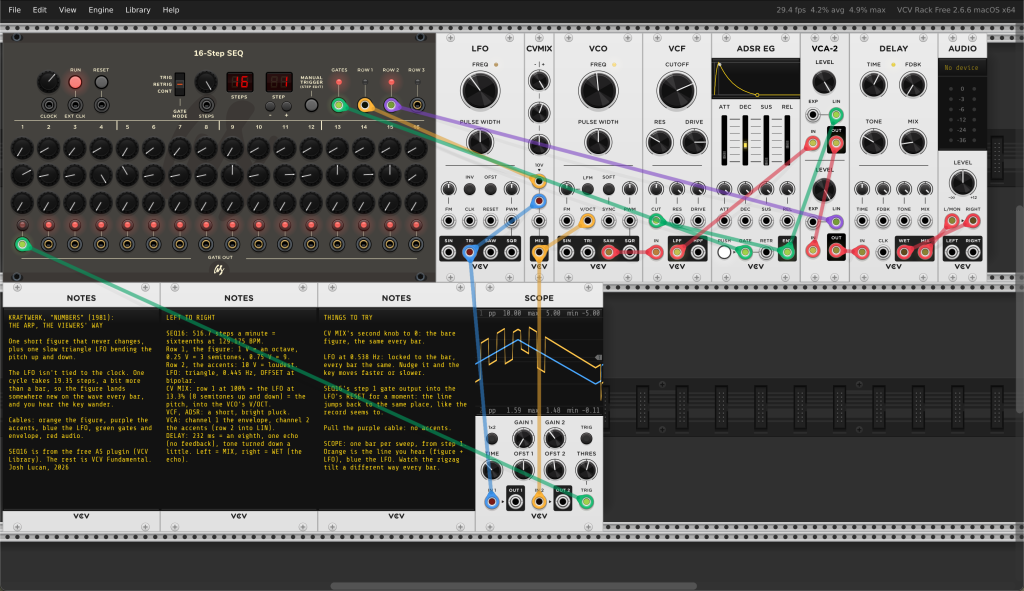
The arpeggio from Kraftwerk’s “Numbers” (Computer World, 1981), the way a viewer of my video explained it: one short
16-step figure that never changes, and one slow triangle LFO bending the pitch up and down. Nothing set per bar. The LFO
runs at 0.445 Hz, a little longer than a bar, so the same figure lands somewhere new on the wave every bar. That’s the key
wandering around that you hear on the record. I tested it against my transcription and it fits better than the model in
my video.
Needs the free AS plugin (for SEQ16) from the VCV Library; everything else is VCV Fundamental, which comes with Rack.
Row 1 of SEQ16 is the figure (1 V = an octave), row 2 the accents. CV MIX adds the LFO to the figure (13.3% = 8
semitones up and down). The delay is an eighth note (232 ms) with the echo on the right channel, roughly like the record.
The scope shows one bar per sweep: the zigzag stays the same, the wave under it moves.
Things to try: turn CV MIX’s second knob to 0 and the wave is gone; set the LFO to 0.538 Hz and every bar comes out the
same.
This is a reading of the record, not Kraftwerk’s patch: nobody has documented what made the wave.
Video: https://youtu.be/xSKQ4AeN5NQ