
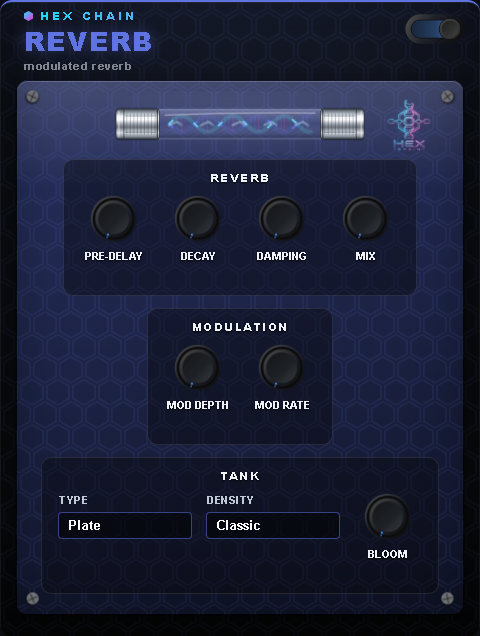
Five reverb machines in one: modulated plate, three-spring tank, a blooming cinematic ambient wash, a studio plate and a stereo hall.
Five reverb machines under one set of knobs:
– PLATE — a smooth, gently modulated tank, from tight room to long lush wash, with a Density switch: Classic keeps the familiar four-comb voicing, Dense runs a bigger eight-comb / six-diffuser tank for a lusher, less metallic tail.
– SPRING — a three-spring tank model with real drip and boing, the outboard-unit sound that surf and early rock records were soaked in.
– AMBIENT — a modern blooming pad reverb: a long, heavily diffused tail whose density GROWS after you stop playing, driven by a dedicated BLOOM control that scales the smear, the late-tail regeneration, the slow evolving motion and the stereo width together. Attack-softening diffusion keeps picking gentle, the modulation is slow and non-pitchy (no chorus wobble), the low end stays clean in long tails, and the width is mono-safe. Play a chord, let go, and listen to it swell.
– STUDIO PLATE — a modern figure-of-eight plate tank: a mono send into two cross-fed halves with seven output taps per side, so the tail is dense, smooth and wide from the first reflection, without the metallic ring of a comb tank.
– HALL — an eight-line feedback delay network with a true stereo send (a stereo chorus or delay in front stays stereo in the tail), long hall-sized lines and slow motion that smooths the modes.
Pre-delay, decay, damping, modulation and a unity-gain wet/dry blend — engaging it never drops your level. All five types are loudness-matched, so switching between them keeps your place in the mix. Decay is a true RT60 on the two new types, and Damping means the same thing on every type. Heavier than the light effects but fine on Pi 4/5; usable on 32-bit Pi with headroom in mind.
Free and open source (GPL-3).
Credit: Ryan Powell
