
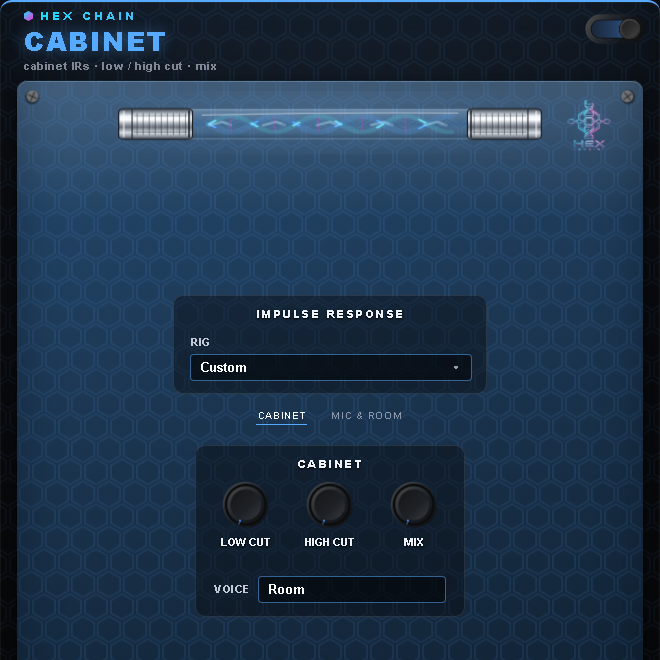
Cabinet sim: ten built-in cabs (guitar AND bass) + your own .wav IRs, a physical speaker model, a draggable two-mic placement pad, Room/Studio voicing, three room densities, and eleven rigs you can extend with your own.
A convolution cabinet with a studio’s worth of mic technique built in.
TEN built-in cabs cover the classics without shipping a single sampled IR: the Factory 4×12 (Thirty-Something ceramic bite), Chime 2×12 (alnico sparkle), American 2×12 (open-back spread), Cashback 4×12 (woody vintage crunch), Hi-Volt 4×12 (big, fast and clean) and Doom 4×12 (huge + dark) — plus FOUR bass cabs: the sealed Bass 8×10 fridge with its 500-900 Hz grind, the deep ported Bass 4×10 with a horn top, the tight mid-forward Bass 2×10, and the round Motown-voiced Bass 1×15 Flip-Top. Each one is synthesized with measured-IR anatomy — cone-breakup ripple, baffle reflections and box resonance — so they fingerprint like real cabs, and they’re loudness-matched so switching never jumps in volume.
MIC PLACEMENT is a draggable pad, not a knob bank: slide the mic from the cap to the cone edge and pull it back up to ~30 cm — position darkens and thickens like moving off-axis, distance trades proximity punch for room air. It works on the built-in cabs AND your own IRs, and it saves with presets.
ROOM ambience adds a compact stereo small-to-medium room behind the cab (toggle, mix and size), so direct rigs stop sounding like a speaker pressed against your eardrum. Also preset-savable — and a Room Density switch picks between the Classic room engine and a Dense variant with a smoother, more even reflection tail.
CAB VOICE picks the perspective: Room is the raw amp-in-the-room sound, Studio runs the ‘recorded’ chain — a second darker virtual mic blended against yours, bracketing filters, a fixed console curve and gentle level-independent bus glue — for that produced, sits-in-the-mix tone. (The Studio chain brackets at 78 Hz — voiced for guitar; keep the bass cabs on Room voice to preserve their fundamentals.)
Load your own .wav impulse responses through the file browser — they’re resampled with windowed-sinc quality, so a 44.1 kHz IR keeps its top end intact. Low-cut, high-cut and dry/wet mix finish the voicing.
Ships making sound out of the box. Free and open source (GPL-3).
v1.19: Speaker Drive gains a PHYSICAL mode — a state-based driver with excursion limits, suspension stiffening, cone breakup and cone cry, calibrated in volts to the amp driving it. MIC 2 adds a second virtual mic with its own type, position, distance, blend, time alignment and polarity, on the same pad. The SPACE room density is an image-source room with early reflections. And a RIG selector under the IR picker applies eleven factory mic/room/speaker setups — one per built-in cab — or your own, saved on the device. The panel splits into CABINET | MIC & ROOM; your own IR files get the basics.
v1.22: LISTEN (on by default) plays the cab the way you hear it standing in front of it on headphones: the floor and walls of a room, the cab aimed at you, two ears. Stand At sets the distance (0.5-4 m) and Room the size; it replaces the cab’s own room while on, and works with your own IRs too.
Credit: Ryan Powell
