
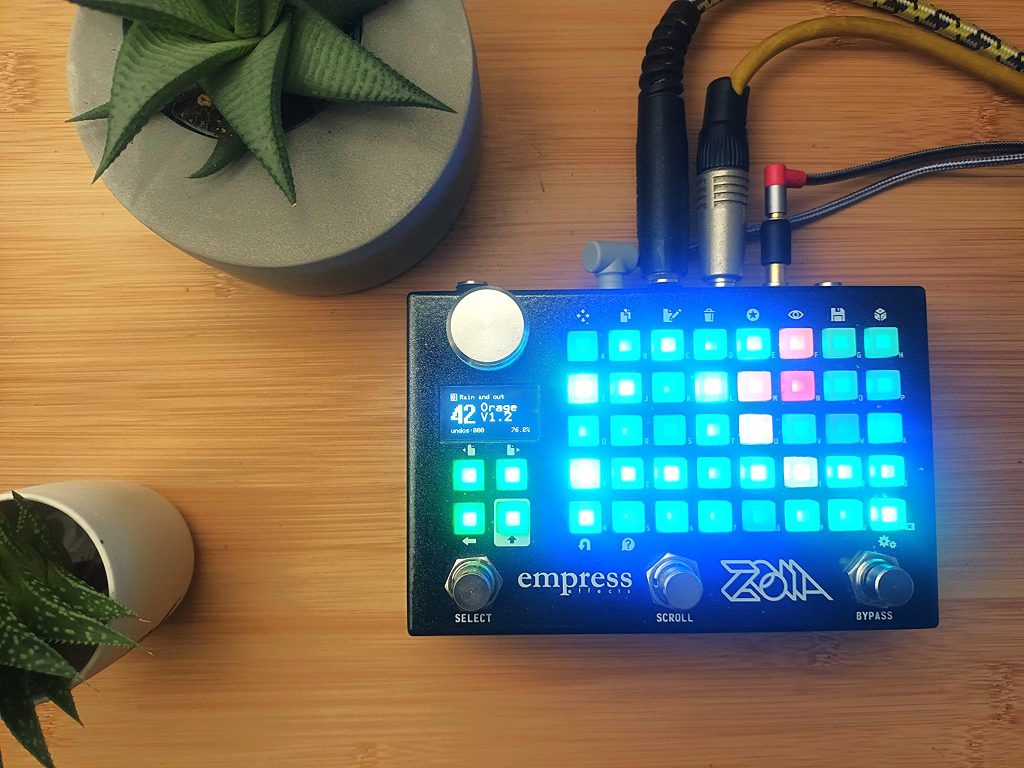
Orage v1.2
Orage is a generative patch producing a rainy day with thunderstorm soundscape, as realistically as I could get it, and sprinkled with very sparse bells notes here and there.
Main page is arranged to evoke a rainy sky, sometimes hit by a lightening
I wasn’t sure about sharing this patch at first, since musically, it is not the most interesting. But over the months, I found great pleasure letting it play in the background for long days working at home, cosy evenings with a nice tea cup, or even sometimes for a full sleeping night.
So maybe some of you will enjoy it too !
Here is the patch diagram using Darosh’s great new patch explorer tool:
https://tinyurl.com/oragezoianpatchexplorer
How it’s made:
The storm distance
I wanted to simulate that « coming and going away » of rainstorm’s intensity which makes rainy days as soothing as they are exciting.
Long periods of soft and far away rain with long muffled rumbling thunders, sometimes even almost nothing, then the excitation comes : The rain is increasing again. How intense will this downpour get ? Will there be big thunders ?
Who knows… and where is my hot chocolate bowl ?
To achieve that, a RANDOM module feeds into 2 slow and non-synced SAMPLE&HOLD which get added together with a faster but smaller range random LFO. This slowly moving random value goes through a long SLEW-LIMITER and control directly the output level of the rain’s VCA and the frequency of rain’s SV-FILTER. It represents the «intensity to the storm ».
The graph of the VCA level input (4th tile, landing page) is good way to visualize it.
It’s also used to compute its complementary value (by adding a -1.0000 VALUE to it before passing it through a CV-INVERT) that we could rather call the « distance to the storm » and which controls all that must increase when the storm is far away (Reverbs’ mix and decay times, thunder’s filter’s sweeping time, probability of bells notes)
The rain
The starting point of this patch was the accidental discovery that plugging a RANDOM module in a sine OSCILLATOR’s frequency produced a sound very reminiscent of the close-up sound of rain drops falling into water.
I then complemented those rain drops with a white NOISE module to add depth and a fuller feeling of a rainy day where you also hear indistinct rain noise coming from afar.
It then gets filtered several times then goes through a REVERB LITE
Rain intensity is inversely proportional to the storm distance
Reverb lite’s mix is proportinal to the storm distance
The thunder :
Very short bursts of a square OSCILLATOR get randomly generated then fed into a long HALL REVERB. This is sent to scoopy FUZZ, then to a band-pass MULTIFILTER. The filter frequency is swiped from high to low by an ADSR whose profile varies with the distance of the storm
The probability of thunder is quite low and independent of the storm distance. Average occurrence time must be around 5 minutes, however 10~15 minutes can easily pass without a single thunder, and you also sometimes get clusters of 3~4 thunders in less than a minute.
The thunder parameters which are proportional to the storm distance are Reverb decay time (for a longer and more rounded thunder and storm is away) and ADSR’s delay time (to keep the harshest part of the transient when the storm is close but muffle it when storm’s away), hold attack time (for short intense strike vs longer rumble) and decay time ( same reason, though this one is set indirectly from the bell’s S&H to add some variability in the thunders profile).
Thunders can be activated at will with the left stompswitch. But for reasons I don’t fully understand, the forced thunders don’t sound as good (way less “organic and natural”) as the ones randomly happening …
The dreamy bells
Nothing fancy here: a QUANTIZER (in F, m Natural) into a sine OSCILLATOR whose VCA is controlled by a short ADSR and feeds back into the OSCILLATOR’s FM input. All this randomly triggered with a probability propotional to storm distance, so that the bells happen more when the storm is calm.
Bells finally pass through an SV-FILTER and into the rain’s REVERB LITE.
Built under Zoia 3.0
CPU usage: usually around 77% and spikes at 88% during thunder
