
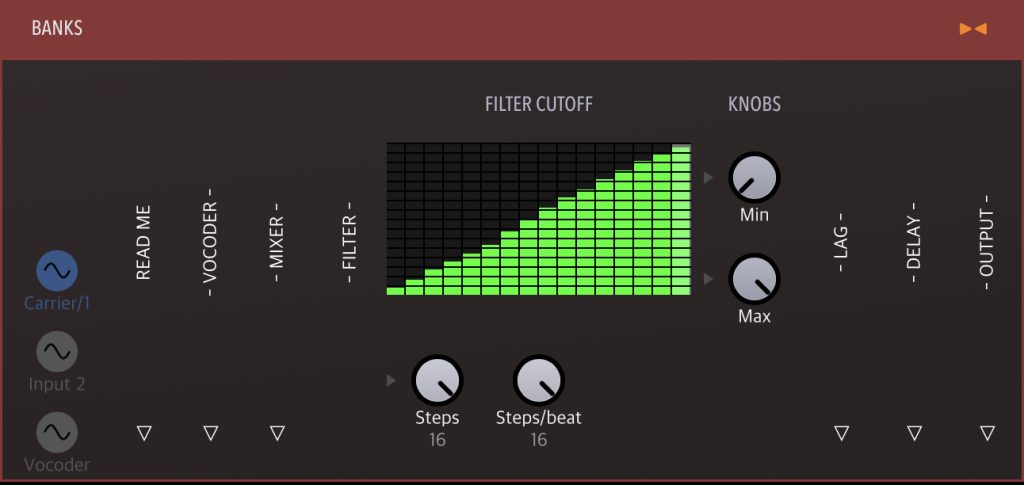
Banks is a 16 band filterbank with a host of per-band controls. It can be used for simple tone shaping, vocoder effects, as well as delay, rudimentary reverb, and quasi sequenced effects. It includes two signal inputs and a modulator input, as well as two separate outputs and a sum output. I was particularly inspired by Fumana, from Frap Tools.
Banks heavily relies on the CV sequencer module to control parameters for the 16 bands.
Filter: sets the cutoff frequency of the 16 separate 48db bandpass filters. While I considered a fixed filter bank design, being able to set the sixteen bands allows for some very interesting tone shaping as well as creative use of the delay functions. The global knobs move the minimum and maximum range of the frequencies up and down respectively, sweeping and scaling the entire filter bank. These knobs can be modulated.
Mixer: set volume, pan, and select which input (1 or 2) per band. Values 0-1 blend between inputs 1 and 2 – there is also a blend knob, which moves all bands between inputs 1-2.
Lag: this controls the static, non feedback delay of the individual bands. There is a per band delay control, as well as global scale, and mode setting. These control the 4 delay modules maximum length, and time mode. This can be used for very mild delay offsets, or for sequenced, rhythmic effects.
Delay: time sets the delay line length, feedback it’s decay in the delay line, both time and feedback have per band settings, as well as controls for the minimum and maximum values of the per band setting. You can control the mode of the delay, as well as the minimum delay time. Mods contains an lfo modulating the delay time, and per band amount and speed controls for the lfo.
Output: Dry/wet for the feedback delay can be set per band, and then scaled by the dry wet knob. An amp is available to adjust volume, as well as a stereo width control. The signal is then crossfades per band between output 1 and 2. The default output for the whole rack is a sum of both output 1 and 2. Using the additional outputs 1 and 2 allows you to send different bands to different processing chains.
Vocoder: requires the use of the Modulator input. Turn the vocoder button on, and adjust the bands of the vocoder. The energy in the bands of the modulator signal will apply volume modulation to the bands of the input signal. Since this is not a fixed filter design, you can turn match on and the vocoder cutoff will control both the mod and carrier banks.
